

Table of contents
Thermal transfer ribbon certification: definition and scope
Why thermal transfer certification matters for Indian industries
Main thermal transfer ribbon certification standards
Thermal transfer certification by industry
Documentation and compliance requirements
Certified thermal transfer ribbons for industrial performance
Thermal transfer certification is now a critical requirement for industrial labeling in India, where manufacturing and export activities continue to expand across packaging, pharmaceuticals, automotive components, electronics, textiles, and chemical industries. Certified thermal transfer ribbon printing ensures barcode readability, product identification, traceability, and compliance with international regulations.
To meet both domestic regulations and global export standards, thermal transfer ribbons used in India must combine certified quality, durability, and consistent print performance. Beyond clean printing results, certified ribbons must comply with strict requirements related to chemical safety, food contact, environmental responsibility, and industrial resistance.
As a global leader, ARMOR-IIMAK supports Indian manufacturers and exporters with certified thermal transfer ribbons designed to deliver quality, efficiency, and long-term reliability across regulated and demanding industrial environments.
Thermal transfer ribbons in industrial printing
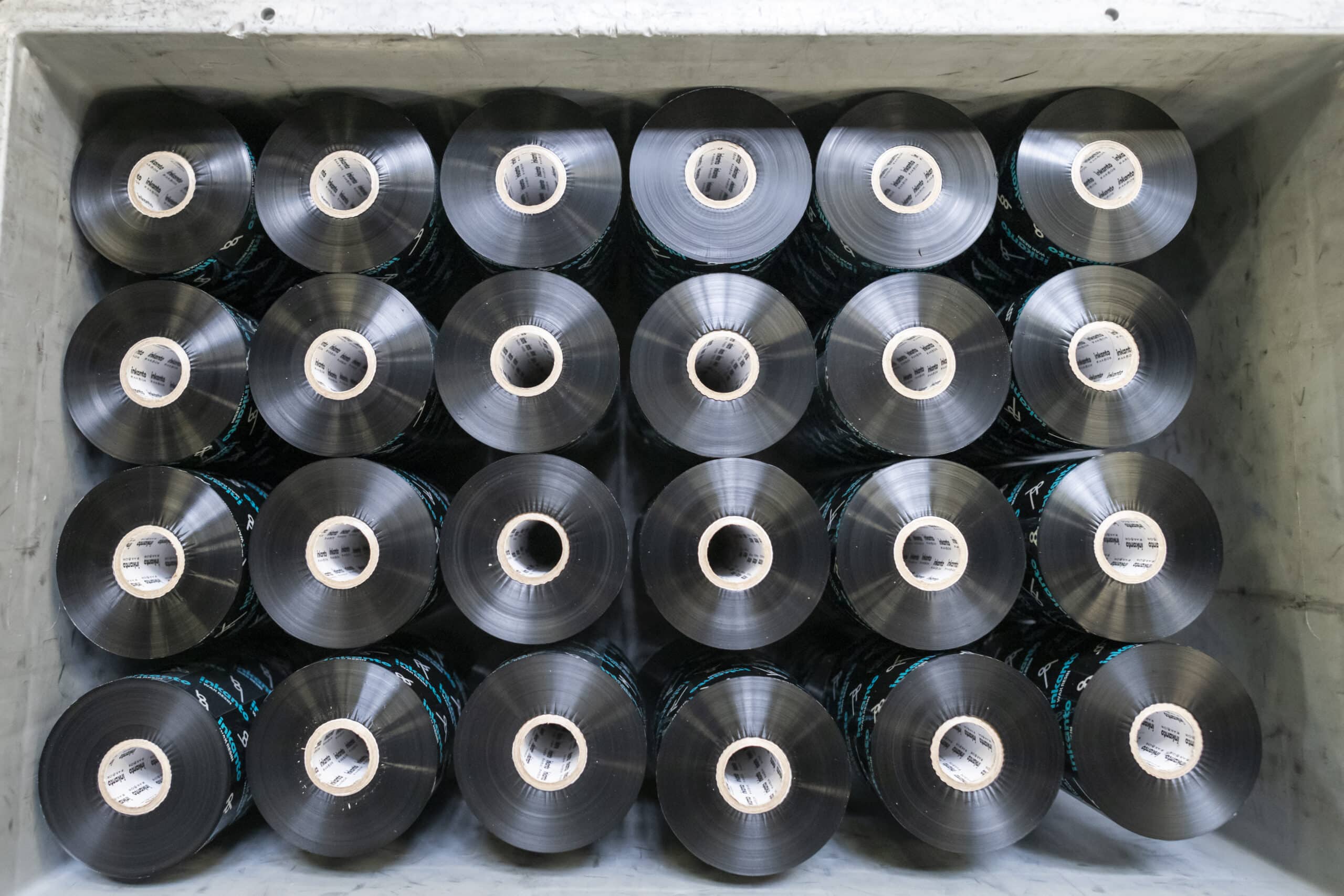
Thermal transfer ribbons (TTR) are used in thermal transfer printing to produce durable industrial labels and barcodes, with wax, wax-resin, and resin formulations selected according to resistance and application requirements.
What is a thermal transfer ribbon certification?
A thermal transfer ribbon certification is an official validation confirming that a ribbon complies with recognized international standards related to:
- Print quality and consistency
- Chemical and environmental safety
- Food, pharmaceutical, or medical suitability
- Durability under heat, abrasion, humidity, and chemical exposure
Certified thermal transfer ribbons ensure that printed labels remain legible, scannable, and compliant throughout storage, transport, and end use—an essential requirement for export-oriented Indian industries.
Why certifications are essential for Indian industries using TTR (Thermal Transfer Ribbons)
Indian manufacturers increasingly operate within global supply chains, supplying products to the United States, Europe, the Middle East, and Asia-Pacific. As a result, thermal transfer ribbons used for barcode labels and industrial printing must meet international compliance standards.
Certifications help ensure that:
- Printed labels comply with import and export regulations
- Barcodes remain readable across logistics and distribution
- TTR printing performance remains stable in high-volume production
- Environmental, health, and safety risks are minimized
ARMOR-IIMAK thermal transfer ribbons comply with major regulations including REACH, RoHS, FDA food contact, ISEGA, UL, and conflict minerals requirements, making them suitable for Indian companies serving regulated global markets.
Why thermal transfer certification matters for Indian export markets
India plays a strategic role in global manufacturing and export supply chains. Companies exporting goods to the US, Europe, the Middle East, and Asia-Pacific must ensure that TTR labels comply with international certification requirements, not only with local practices.
Certified thermal transfer ribbons help Indian manufacturers:
- Avoid shipment rejection or relabeling at customs
- Meet importer, distributor, and brand owner compliance requirements
- Pass quality audits and regulatory inspections
- Secure long-term access to regulated export markets
In export-driven industries, thermal transfer certification directly impacts business continuity and market access, not just print quality.
Main categories of thermal transfer ribbon certifications
Quality and management systems
- ISO 9001 – Ensures consistent quality in ribbon manufacturing
- ISO 14001 – Confirms environmental management practices
- ISO 45001 – Covers occupational health and safety
Environmental and chemical compliance
- REACH – Controls restricted substances in ribbon ink formulations
- RoHS – Limits hazardous materials used in industrial printing supplies
- WEEE – Supports responsible handling of electronic waste
- Packaging & heavy metals directive (94/62/EC) – Limits heavy metals in packaging
- Halogen-free & BPA-free compliance – Enables safer, eco-friendly labeling
Food, pharmaceutical, and medical applications
- FDA 21 CFR – Required for food-contact labels in export markets
- ISEGA – Confirms compliance with EU food packaging regulations
- USP Class VI / EU 10/2011 – Validates suitability for pharmaceutical and medical labeling
Industry-specific performance certifications
- UL 969 – Ensures label durability under heat, abrasion, and chemicals
- BS 5609 – Confirms resistance of printed labels to seawater exposure
- Automotive standards (AIAG, VDA) – Support barcode traceability in automotive supply chains
- IATA & DOT 49 CFR – Define requirements for hazardous materials labeling
Ethical and sustainability standards
- Conflict minerals compliance – Supports responsible sourcing
- FSC certification – Ensures sustainable paper sourcing for labels
- Carbon footprint programs – Track and reduce emissions
- OEKO-TEX® Standard 100 – Confirms textile labels are safe for skin contact
Typical thermal transfer ribbon certifications by industry
| Industry | Applications | Recommended certifications |
| Food & Beverage | Packaging labels, food traceability, barcode printing | FDA 21 CFR, ISEGA, REACH, BPA-free |
| Pharmaceuticals & Healthcare | Medical labels, compliance printing | USP Class VI, EU 10/2011, FDA 21 CFR |
| Automotive | Component labels, barcode traceability | UL 969, AIAG, VDA |
| Chemical Industry | Drum labels, hazardous goods | BS 5609, REACH, RoHS |
| Textiles & Apparel | Textile labels, garment identification | OEKO-TEX® 100, FSC, ISO 14001 |
| General Manufacturing & Logistics | Shipping labels, warehouse identification | ISO 9001, ISO 14001, RoHS, WEEE |
Comparative overview of key certifications
| Certification | What it covers | Industries |
| REACH | Restriction of hazardous substances | All industries |
| RoHS | Limits heavy metals and hazardous materials | Electronics, Automotive, Industrial |
| FDA 21 CFR | Food contact safety | Food & Beverage, Pharma |
| ISEGA | EU food packaging compliance | Food & Beverage |
| UL 969 | Label durability under stress | Automotive, Electronics, Logistics |
| BS 5609 | Marine durability for chemical drums | Chemicals, Marine transport |
| USP Class VI | Medical and pharmaceutical safety | Healthcare, Pharma |
| FSC | Sustainable paper sourcing | Packaging, Retail |
| OEKO-TEX® 100 | Textile labels safe for skin | Apparel, Textiles |
Documentation required for certified thermal transfer ribbons
For certified thermal transfer ribbon (TTR) applications, manufacturers, converters, and brand owners typically require formal documentation to support compliance and audits:
- Declarations of conformity (REACH, RoHS, food contact regulations)
- Safety Data Sheets (SDS)
- Test reports covering durability, abrasion, chemical resistance, and heat exposure
- Traceability documentation for quality audits and inspections
Using certified thermal transfer ribbons simplifies customer validation, internal quality controls, and third-party audits, especially for Indian companies operating across multiple export markets.
Performance and durability in industrial printing environments
In Indian industrial conditions—high temperatures, humidity, abrasion, and chemical exposure—thermal transfer ribbons must deliver more than visual quality.
ARMOR-IIMAK thermal transfer ribbons provide:
- Consistent ink transfer and print density
- Long-lasting barcode readability
- Compatibility with high-speed thermal transfer printers
- Reliable performance across paper and synthetic labels
This ensures durability, quality, and efficiency throughout the full supply chain.
Why choose ARMOR-IIMAK thermal transfer ribbons in India?
Selecting the right thermal transfer ribbon directly impacts printing efficiency, label quality, and regulatory compliance. ARMOR-IIMAK offers Indian manufacturers:
- A full range of wax, wax-resin, and resin ribbons
- Certified products compatible with major printer brands
- Proven industrial performance
- Global compliance aligned with Indian export needs
ARMOR-IIMAK is a trusted partner for industrial thermal transfer ribbon solutions combining performance, durability, and responsibility.
How to choose the right certified thermal transfer ribbon
Quick checklist
- Identify label material and printing requirements
- Select ribbon type (wax, wax-resin, resin)
- Confirm printer compatibility, roll length, and core size
- Match certifications to industry and export markets
- Request technical documentation and certificates
Certified thermal transfer ribbons for reliable industrial printing
Certification is not just a regulatory obligation—it is a guarantee of quality, safety, and operational efficiency.
By choosing certified thermal transfer ribbons from ARMOR-IIMAK, Indian manufacturers secure reliable printing performance while meeting the highest international standards.
Explore certified thermal transfer ribbon solutions and discover how ARMOR-IIMAK supports compliant, durable, and high-performance industrial labeling in India.